
Mau Binh U888 introduces a game of structure, probability, and competitive rhythm where hands are arranged into three calculated lines. Unlike shedding games, success depends not on speed, but on deliberate formation and steady evaluation. With the right mindset, beginners can adapt quickly while strategic players refine their decisions for more reliable wins.

General Overview of Mau Binh U888 Gameplay
Mau Binh (Chinese Poker) uses a 52-card deck where each player receives 13 cards and must arrange them into three separate hands: front, middle, and back. Each line must follow ranking rules where the back is strongest, the middle is second strongest, and the front contains the weakest value. The balance between structure and risk defines the identity of Mau Binh U888, rewarding thought rather than impulse.
Because the game revolves around arrangement instead of turn-based release, reading card potential becomes a primary prerequisite. Strong players visualize combinations before placement rather than forcing structure without awareness. The challenge lies not in card movement, but in shaping three lines that defeat multiple opponents simultaneously.
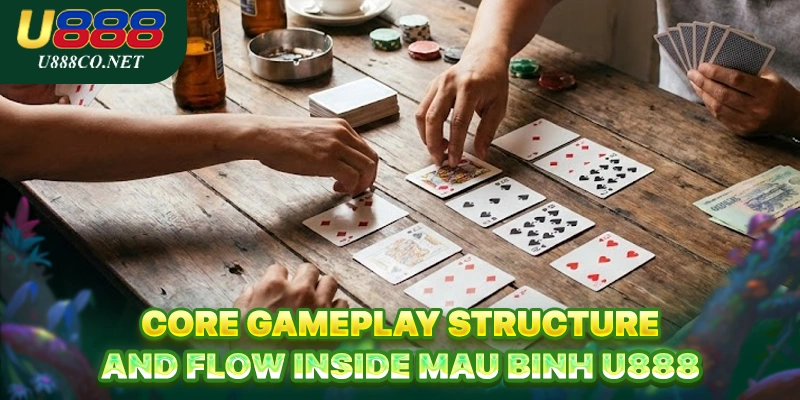
Core gameplay structure and flow inside Mau Binh U888
Key Rule Framework Inside Mau Binh U888
Before learning how to arrange cards effectively, players must understand ranking, structure limitations, and the penalty system. A misplaced formation can collapse an entire round, even if card values were strong initially. Foundation knowledge controls momentum, reduces confusion, and increases clarity long-term.
Card hierarchy defined from peak value down to lowest tier
A solid ranking understanding allows players to identify which cards contribute value and which become liability under pressure. Without hierarchy awareness, arrangement becomes random and unstable. New learners should memorize ranking order before practice begins.
In Mau Binh U888, the strongest patterns include straight flush, four-of-a-kind, full house, flush, straight, three-of-a-kind, two pairs, one pair, and high card last. The back line typically carries the highest value because it supports overall scoring weight. Meanwhile, the front line holds only three cards, demanding precision rather than excess.
Misplaced power wastes potential. A strong pattern positioned in the wrong line fails to outperform a weaker—but structurally correct—formation. Correct placement matters more than raw card strength.
Line requirements and structural integrity rules
Before pushing for advanced arrangement, players must understand that a breakdown of order results in an automatic loss. If the top is stronger than the middle or the middle outranks the bottom, the entire hand becomes a foul. Precision and order outplay decorative risk every time.
Mau Binh U888 enforces line strength discipline: Back > Middle > Front — no exceptions. If one line violates this order, the entire layout folds. Therefore, caution outweighs aggression when decisions feel uncertain. Balanced structure consistently wins more games than risky imbalance. Safety is a strategy—not hesitation.
Scoring system and payout interactions
Understanding scoring equips players with the ability to choose between safe formation or aggressive conversion. Points reward structure that wins multiple line comparisons rather than singular success. Victory feels earned through layered evaluation instead of single-move dominance.
In Mau Binh U888, scoring compares each of your lines with every opponent’s lines individually. Points accumulate for each successful comparison, and bonuses appear for special patterns like Dragon (13-card straight) or Six Pairs. Penalties activate naturally if the hand fouls due to incorrect order.
Knowledge of scoring mechanics encourages stable decision-making and reduces late-game collapse. Order builds advantage; chaos erodes it.
Point evaluation and reward distribution under Mau Binh U888 rules

Step-By-Step Guide: How to Play Mau Binh U888 Smoothly
New players learn fastest through structured progression: visualization, arrangement, confirmation. Instead of reacting emotionally, strong learners follow repeated formation logic, producing the same result with less stress each session.
Initial card reading and grouping
The opening view of 13 cards determines strategy. Identifying pairs, sequences, or suit concentration builds a foundation for arrangement. Without this step, players guess blindly and weaken long-term outcomes.
Mau Binh U888 players often begin by grouping cards by rank or suit on first glance. This separates dead values from high-potential assets. Clusters help visual alignment, reduce confusion, and produce consistency in decision-making. Organized players outperform emotional players. Vision guides execution.
Building back, middle, and front hands
Once clusters appear, formation becomes mathematical. Strongest sets belong in the back, supportive sets belong in the middle, and lowest cards finalize the front. Precision determines victory.
Mau Binh U888 rewards players who balance strength across lines instead of stacking everything in one. The best formation is not the one containing the strongest combo—it is the one where all three lines win more comparisons than they lose. Arrangement is less about power and more about distribution. Spread value; don’t bury it.
Final validation and foul prevention
Before confirming layout, players must ensure structural integrity: top < middle < bottom. A single oversight ruins perfect potential and converts advantage into complete defeat. Validation is not optional.
In Mau Binh U888, the final moments before locking a formation require slow, precise checking. Review ranking order, reposition if needed, and clear imbalance carefully. Accuracy prevents collapse and evolves gameplay stability. A cautious five-second review wins more games than a rushed 30-second gamble.
Transitioning from Beginner to Strategy-Driven Player
Once rules feel natural, improvement shifts into foresight, probability thinking, and adaptive decision-making. New players grow into evaluators — less reaction, more intention. Experience reduces mistakes more than luck ever will.
Progressing beyond beginner level into tactical thinking in Mau Binh U888
Tracking patterns and anticipating opponent formation
Observation allows players to predict how others arrange their hands. If pairs appear frequently, expect full house or two-pair builds across the table. If suits distribute evenly, flush becomes unlikely and straight gains higher value.
In Mau Binh environments, the difference between average and advanced players is memory precision. Tracking rank flow and distribution guides defensive or offensive shaping. When you know what others likely build, you shape accordingly.
Defensive layouts when hand distribution is weak
Not every deal produces brilliance. Some rounds are survival-focused, where minimizing loss is success. Defensive shaping protects score position without forfeiting structure.
Mau Binh U888 supports cautious play by prioritizing balance over ambition. Low pairs make strong frontline choices, while medium-value sets create stable middle support. A small win is still advancement — a small loss is still preservation.
Assertive formation when opportunity arises
When cards align well, aggressive structure becomes efficient. However, offense must remain supported by stability beneath it. High reward exists only when risk is controlled.
Mau Binh strategy shines when a strong hand fills back and middle while leaving a competitive front. This creates a multi-line advantage while holding foul risk low. Winning three lines requires layered reinforcement, not reckless stacking.
Conclusion
Mau Binh U888 stands as a card game defined by structure, calculation, and thoughtful distribution rather than impulsive play. When beginners understand ranking, line formation, and validation techniques, decisions become clearer and outcomes more stable. With continued practice and a calm approach to arrangement, mastery grows naturally and performance strengthens over time.
